
If you search "best stocks for wheel strategy 2026" you'll find a dozen articles with the same 10 tickers. AAPL. TSLA. MSFT. Maybe some ETFs.
The problem is those lists are written once and never updated. A stock that was a great wheel candidate in January might be a terrible one in March — different IV environment, upcoming earnings, changed sector rotation. By the time you read a static list, it's already stale.
So instead of giving you another list that expires the moment you finish reading it, this article is going to do two things: teach you the 4 criteria that actually make a stock wheel-worthy, and then show you what those criteria look like using live data from right now.
What Is the Wheel Strategy?
Quick recap for anyone newer to this. The wheel is a three-step options selling cycle:
- Sell a cash secured put on a stock you'd be willing to own
- If assigned, you now own 100 shares — start selling covered calls above your cost basis
- If called away, your shares get sold at the strike price — go back to step 1
The goal is to collect premium at every step. The put premium lowers your effective entry price. The covered call premium generates income on the shares while you hold them. Done consistently on the right stocks, it's a durable income strategy.
The keyword there is "right stocks." The wheel doesn't work on everything. And that's exactly what most articles get wrong.
The 4 Things That Actually Make a Stock Wheel-Worthy
Before you run a single scan, here are the four criteria that matter:
1. Implied Volatility High Enough to Generate Real Premium
IV drives premium. Low IV means low premium means you're risking assignment for pennies. You want stocks with enough IV to generate meaningful income — but not so high that you're essentially playing earnings every week.
A good target: IV in the 30-80% range. Below 30% and the premium barely moves the needle. Above 80% and you're usually looking at a stock with binary risk that doesn't belong in a wheel.
2. Options Liquidity — Tight Bid-Ask Spreads
Wide spreads kill your edge before you even get in. If a stock's options have a $0.30 bid and a $1.50 ask, you're giving up a huge chunk of premium just on the transaction.
You want stocks where the bid-ask spread on the options you're selling is tight — ideally under 15% of the mid price. This means the stock has active options volume and institutional participation in the chain.
3. A Price Range You Can Actually Work With
The wheel requires owning 100 shares if assigned. A $700 stock means $70,000 in collateral for one put. That's fine if you have the capital, but most retail traders running the wheel want stocks in the $20-$300 range where they can diversify across multiple positions.
Lower-priced stocks with good IV and liquidity are often the sweet spot — enough premium to be worth selling, enough flexibility to run multiple positions simultaneously.
4. A Stock You'd Actually Be Okay Owning
This is the one most people skip. If you sell a put and get assigned, you now own 100 shares. If the stock keeps falling, you're holding a losing position while selling covered calls to dig out.
Only run the wheel on stocks you genuinely believe in long-term. If you wouldn't want to own it at the strike, don't sell the put. The wheel is not a way to get premium on garbage stocks — it's a way to get paid while waiting to enter quality names at a discount.
What to Avoid
Earnings landmines — selling a put 3 weeks before earnings thinking you have time is how you end up assigned into a 15% gap down. Always check days to earnings before entering a wheel position. Give yourself at least 30-45 days of earnings-free runway.
Low open interest — if there are only 5 contracts of open interest at your strike, the market maker owns you. Stick to strikes with at least 50-100 contracts of open interest.
High-beta momentum names — TSLA, NVDA, MSTR look great on paper because the IV is high. But the realized volatility matches. You can collect $500 in premium and lose $3,000 on assignment in the same week. The wheel works best on stocks with a beta close to 1 or below — names that grind, not names that fly.
What Wheel Candidates Look Like Right Now
I pulled live data from StrikeScan this morning — 60,000+ contracts scanned across 5,000+ tickers, filtered for beta between 0.5 and 1.5, no upcoming earnings, tight spreads, and real premium. Here are four real examples that fit all the criteria right now, one per sector:
Walmart (WMT) — Consumer Defensive
- Current price: $125.99 | Beta: 0.66
- Strike: $123 put, April 24 expiration (39 DTE)
- IV: 27.9% | Historical probability OTM: 80.0%
- ROI if expired worthless: 2.58% | Annualized ROI: 24.2%
- Days to earnings: 66 (no earnings before expiration)
WMT is the definition of a stable wheel stock. Beta of 0.66 means it moves less than the market. 80% historical probability at the $123 strike. 66 days to earnings — plenty of runway. The ROI is lower because the stock is less volatile, but that's the trade-off. Less premium, less chaos. For traders who want to run the wheel consistently without drama, WMT is exactly the kind of name that works year after year.
Cameco Corporation (CCJ) — Energy
- Current price: $110.31 | Beta: 0.97
- Strike: $100 put, April 17 expiration (32 DTE)
- IV: 64.0% | Historical probability OTM: 79.2%
- ROI if expired worthless: 3.88% | Annualized ROI: 44.2%
- Days to earnings: 52 (no earnings before expiration)
CCJ is the largest publicly traded uranium company. Nuclear energy is having a moment — data centers need clean baseload power and uranium is benefiting. Beta of 0.97 means it moves roughly in line with the market. The $100 strike is 9% below current price, 79% historical probability, and 52 days of clean earnings runway. Solid premium for a name with real fundamental support.
Boston Scientific (BSX) — Healthcare
- Current price: $69.79 | Beta: 0.70
- Strike: $66 put, April 10 expiration (25 DTE)
- IV: 47.7% | Historical probability OTM: 86.1%
- ROI if expired worthless: 2.69% | Annualized ROI: 39.3%
- Days to earnings: 37 (no earnings before expiration)
BSX is a medical device company — pacemakers, stents, minimally invasive surgery equipment. Beta of 0.70, 86% historical probability at the $66 strike, and 37 days to earnings. Healthcare tends to hold up well in volatile macro environments which makes BSX a natural wheel candidate when the broader market is choppy. The annualized ROI of 39% on a 0.70 beta stock is genuinely attractive.
Constellation Energy (CEG) — Utilities
- Current price: $305.58 | Beta: 1.11
- Strike: $290 put, April 17 expiration (32 DTE)
- IV: 55.8% | Historical probability OTM: 76.1%
- ROI if expired worthless: 4.40% | Annualized ROI: 50.1%
- Days to earnings: 50 (no earnings before expiration)
CEG is the largest nuclear power producer in the US — another beneficiary of the AI data center power demand theme. Beta of 1.11 is slightly above market but still reasonable for a utility. The $290 strike is 5% below current price with 76% historical probability and 50 clean days to earnings. Strong premium for a utilities name because nuclear energy has been a hot sector with elevated IV.
The Part Nobody Talks About: IV Rank Matters More Than Raw IV
A stock with 40% IV sounds decent. But if that stock's IV has been ranging between 35% and 85% over the past year, 40% means you're selling at the low end of its range — the premium is actually cheap relative to what you could get.
IV Rank tells you where current IV sits relative to its own 52-week range. An IV Rank of 80% means the stock is in the top 20% of its most volatile range for the year — premium is as rich as it gets. An IV Rank of 10% means you're getting historically cheap premium.
For wheel candidates, you want IV Rank above 30% at minimum. Below that you're selling premium when it's historically cheap, which is the opposite of what you want.
What the Wheel Actually Looks Like in Practice — A Real Example
I want to show you something real. Not a winner — a trade that went against me.
I got assigned on Figma (FIG) at $35. I had two put positions assigned in January 2026, giving me 600 total shares at an average cost of around $35. The stock kept dropping. That happens — it's part of running the wheel.
Here's what I didn't do: panic sell or let the position sit unmanaged.
Instead I started selling covered calls against my 600 shares consistently. Every contract I sold collected premium and chipped away at my cost basis. By doing this, I've brought my adjusted cost basis down from $35 to $32.55 — and I'm continuing to reduce it with each covered call I write.
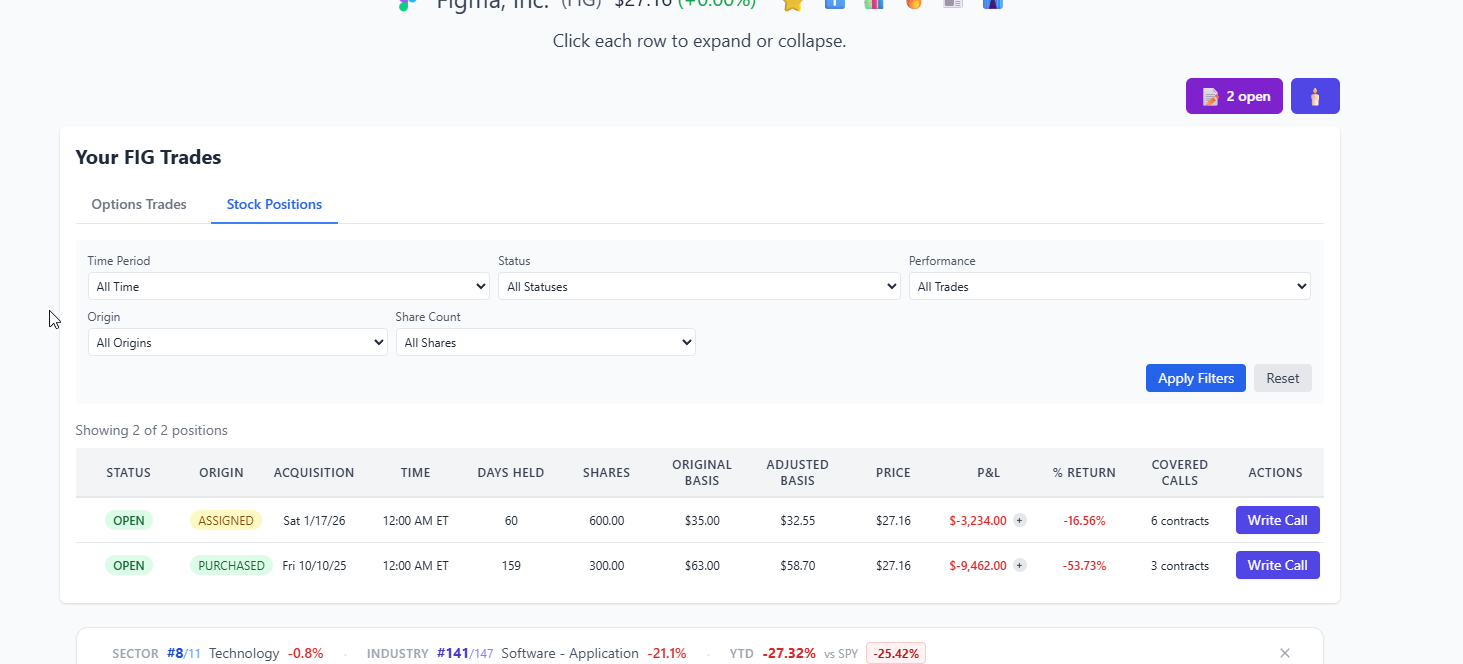
I'm not sharing this because it's a win. I'm sharing it because this is what the wheel actually looks like in real life. Trades go against you. The strategy is how you manage it when they do — and that requires knowing exactly where you stand at every step.
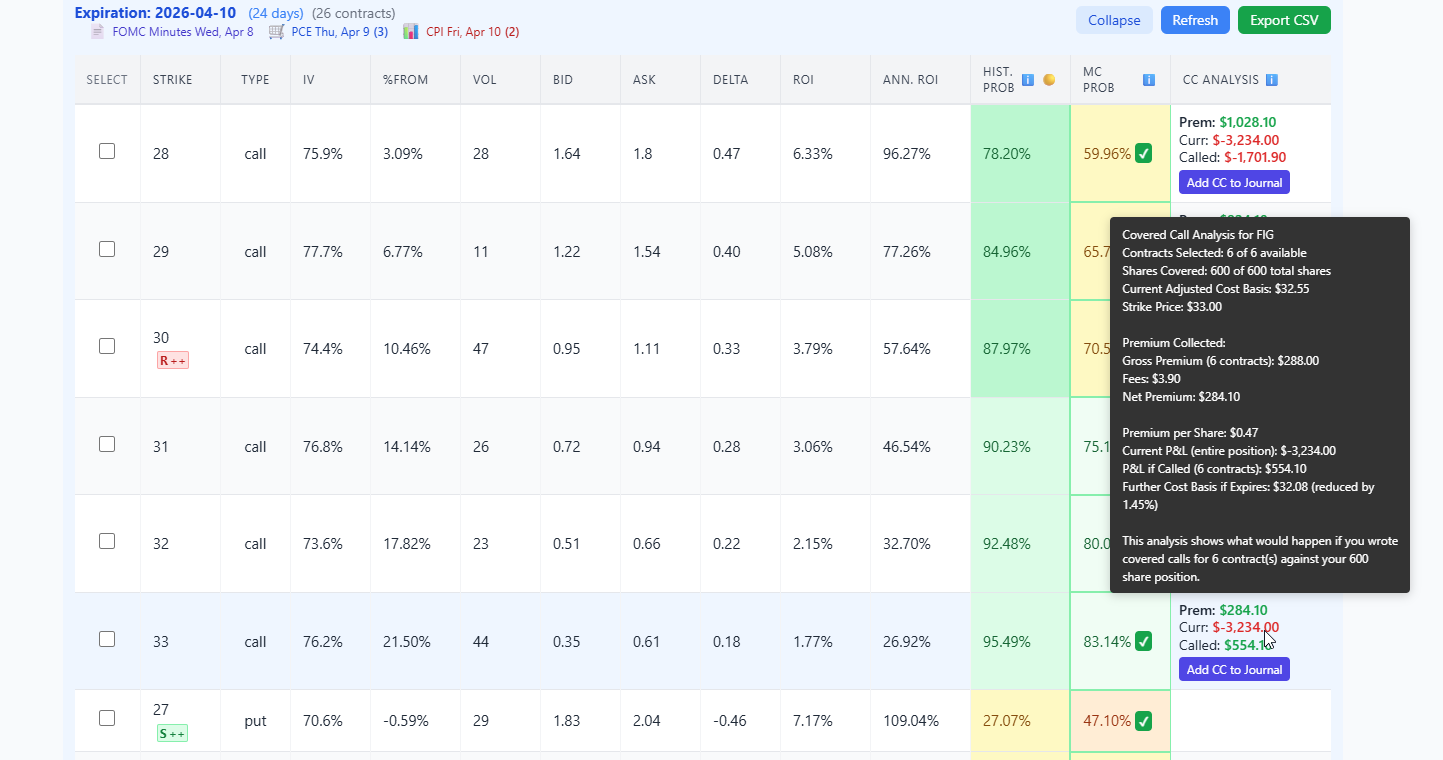
This is why tracking the wheel properly matters. StrikeScan automatically updates my adjusted cost basis after every covered call I write. When I pull up the FIG options chain and click "Write Call," the platform shows me exactly what happens at each strike — the premium I'd collect, my P&L if the shares get called away, and what my further reduced cost basis would be if the call expires worthless.
And the full cycle is tracked in my journal — every put sold, every assignment, every covered call written, all linked together automatically.
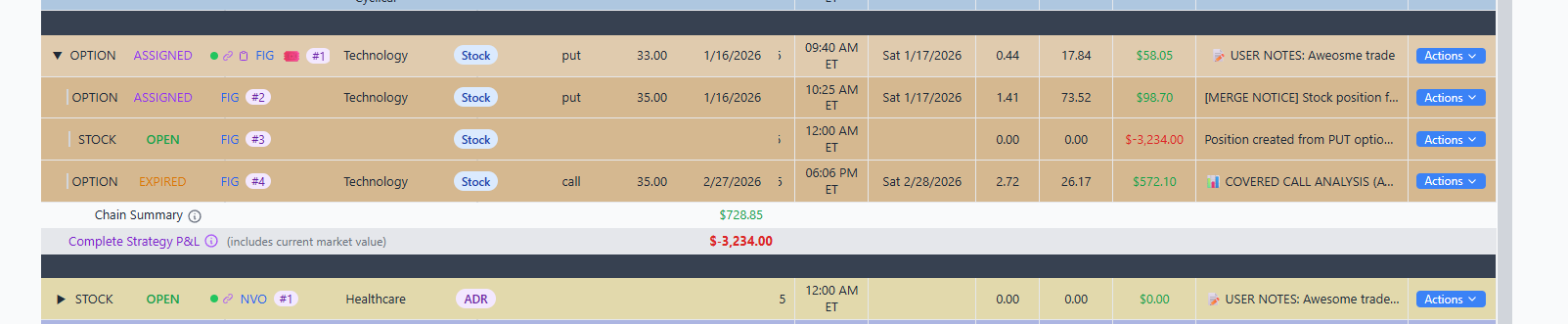
Without that, I'd be doing this math in a spreadsheet and probably getting it wrong. With it, I always know my number and can make a clear decision at every step of the cycle.
The wheel is a process, not a prediction. Track it like one.
How to Find Wheel Candidates Every Week
Here's the honest truth: doing this screening manually is painful. Checking IV rank, probability, earnings dates, beta, spread width, and open interest on ticker after ticker across thousands of stocks takes hours.
I built StrikeScan because I wanted to do for options what Amazon scanning software did for textbook arbitrage — scan the whole market for the inefficiency instead of checking things one at a time.
StrikeScan scans 60,000+ live options contracts across 5,000+ tickers every 15 minutes. You can filter by probability, ROI, IV rank, beta, sector, days to earnings, and spread quality — and surface wheel-ready candidates in seconds instead of hours.
The criteria don't change. The stocks that fit them do — every single week. That's exactly why a static list is useless. And exactly why having a scanner that pulls live candidates every morning is the only sustainable way to run this strategy at scale.
The Honest Truth About the Wheel in 2026
The wheel still works. The strategy hasn't changed.
What has changed is the macro environment. VIX has been elevated — currently in the low-to-mid 20s — which means premium is higher than average, but realized volatility is matching it. You can't just sell puts on anything and collect rent. You need to be selective about which names you run the wheel on, size carefully so no single assignment wrecks your account, and pay attention to the macro backdrop before entering new positions.
The four examples above — WMT, CCJ, BSX, CEG — all fit the criteria today. By next week some of them might not. IV changes, earnings windows shift, sector rotation happens.
Run the criteria, not the list.
Related Reading
Cash Secured Put vs Covered Call · The Best Stocks for Cash Secured Puts · My Pre-Trade Checklist for Selling CSPs and Covered Calls
Disclosure: I am the founder of StrikeScan, the platform referenced in this article. I do not currently hold positions in WMT, CCJ, BSX, or CEG. I do currently hold a position in FIG referenced in the wheel tracking example above. This is not financial advice.